


CASE STUDIES
Rebuilding a Business While It Kept Running
An almost five-year transformation viewed through the Seven Business Flows
Organization
Local Veterans' Organization
Role
Manager
Length of Engagement
Nearly five years
This transformation didn't have one Flow at a time.
Some problems were urgent. Some work happened at the same time.
Other work had to wait.
The seven Flow stories below are seven ways of looking at the same transformation.
The Flows overlap because the business does.
HOW TO USE THIS PAGE.
Each Flow is a case study.
Read through or jump to the Flow that interests you the most.





Operational Flow
Rebuilding the daily operation while the doors stayed open
Establishing consistent daily systems for staffing, scheduling, transactions, cash accountability, inventory, opening and closing, communication and security.
WHERE OTHER FLOWS ENTERED


Flow removed: Marketing

Information Flow
Turning scattered information into something we could use
Creating ways to capture, organize, access and share information so decisions no longer depended on individual people or scattered paperwork.
WHERE OTHER FLOWS ENTERED


Financial Flow
Creating financial visibility, accountability and better decisions
Building financial controls and reporting that provided clarity, supported better decisions and strengthened compliance and accountability.
WHERE OTHER FLOWS ENTERED
Flow removed: Marketing

Customer Flow
Creating a place people wanted to be
Strengthening the everyday experience, rebuilding community relationships and creating an environment where members and guests wanted to return.
WHERE OTHER FLOWS ENTERED

WHERE OTHER FLOWS ENTERED
Marketing Flow
Making the organization visible again
Creating consistent ways to share what the organization was doing and making its growing activity and community involvement visible.

Fulfillment Flow
Building the capacity to reliably deliver more
Developing repeatable ways to support events, food sales, fundraising and community initiatives while the everyday operation continued.
WHERE OTHER FLOWS ENTERED

Strategic Flow
Building a structure the organization could continue to grow on
Addressing the larger organizational structure after creating enough stability underneath it to complete a complex restructuring without disruption.
WHERE OTHER FLOWS ENTERED

The Flows overlap because the business does.
Every business has the same seven Flows.
Friction in one Flow affects all the others.

Operational Flow
Rebuilding the Operation While the Doors Stayed Open
WHERE IT STARTED
I knew I was walking into a difficult situation when I became the manager of a local veterans' organization. I had worked there before, so I already understood some of the challenges.
The organization had been operating for many years without consistent systems for some of the most basic parts of the business.
Day-to-day operations depended heavily on individual employees knowing what needed to be done and handling it in their own way. Opening, closing, cleaning, inventory and shift responsibilities weren't clearly defined. Communication was informal and information didn't always reach the person who needed it.
The physical workspace reflected some of that inconsistency. Storage had developed organically over the years, paperwork accumulated wherever there was room and important operational and financial information didn't have a reliable place to go.
The technology and financial controls needed attention too. The existing POS system was outdated and difficult to use. There wasn't a consistent process for reconciling sales, shift money and the various cash funds used throughout the operation. There wasn’t a reliable paper trail so even a simple discrepancy could take considerable effort to understand.
These operational problems were also connected to much larger organizational issues. The organization was working through overdue tax filings, licensing and regulatory concerns, payroll practices and years of incomplete financial and administrative records.
I was looking at years of systems, habits and workarounds that had accumulated around an organization that still needed to open its doors and operate every day.
There wasn't just one operational problem to fix. We needed to create an operation.
WHAT HAD TO COME FIRST
One of the first things I did was make the case for replacing the POS.
I knew we couldn't create meaningful financial or employee accountability if we couldn't reliably track what was being sold in the first place.
We chose a local company that specialized in systems for bars, beer distributors and liquor retailers. The system wasn't specifically designed for a veterans’ organization, so purchasing it was only the beginning.
I customized it around the way our bar actually operated, including employee access, the time clock, tips, regular and happy-hour pricing and inventory. I built categories for everything we sold and manually entered every product, including the individual product photos. We also added the vendor's integrated credit-card reader so we could properly accept and track credit-card sales.
The company provided system training, but I knew training someone to use software wasn't the same thing as creating a repeatable process around it. So, I created a POS cheat sheet covering the things bartenders needed regularly: signing in, logging in, running credit cards, opening, closing and other common functions.
Then I created the Daily Shift Report and that changed much more than the POS did by itself.

WHERE OTHER FLOWS ENTERED
Information Flow: Information systems created the daily visibility we needed for daily routines, inventory tracking, financial reporting and communication to work.
Financial Flow: Financial tracking, daily counts and reconciliations informed operational decisions, pricing, inventory management and staffing levels.
Customer Flow: Customer feedback, attendance patterns and engagement helped shape hours, staff scheduling, products and events.
Fulfillment Flow: Inventory management, ordering and vendor relationships supported smooth daily operations and ensured we could consistently meet demand.
Strategic Flow: Long-term goals and organizational changes determined operational priorities, required new systems and shaped how we captured daily work.

CREATING ACCOUNTABILITY AROUND EVERY SHIFT
Bartenders became responsible for documenting their POS sales and other shift-level payouts.
They counted their assigned bank bags at the beginning and end of every shift and signed off on the amounts with their initials and date.
At shift change, the incoming bartender recounted the outgoing bartender's bag. If the amounts didn't match, the discrepancy was questioned instead of simply being passed along. Any shortage had to be documented on the Daily Shift Report, along with what the bartender had done to try to correct it.
Sometimes I still had to reconstruct the paper trail myself. What was interesting was that we usually found the money. A shortage might turn out to be cash that had been placed into an envelope for preorders for an upcoming food sale or money that had simply ended up in the wrong place.
Before, we would have known only that money appeared to be missing. Now we had enough information to follow the transaction backward and determine what had actually happened.
The system wasn't simply there to catch someone doing something wrong… it gave us the ability to distinguish a financial problem from a process mistake.
BUILDING A RELIABLE STAFF
At the same time, some existing bartenders were leaving and we needed reliable replacements.
I recruited experienced bartenders I already knew and trusted because I knew their work ethic and reliability. We also hired one bartender who came recommended by members.
The staffing structure needed work too.
The organization had been using a weekly schedule that routinely left difficult-to-fill weekend shifts open. Group texts went out every week asking people to cover them. I changed that to a monthly schedule and I asked each bartender which shifts they preferred, which days and nights worked best and how many shifts they actually wanted. That became our basis for scheduling.
The following month's schedule went out by the last Thursday of the current month, and time-off requests needed to be submitted before that cutoff.
Call-offs were relatively infrequent once we had the right people in place. If someone did call off, they were responsible for first trying to find their own replacement. I stepped in if they couldn't get responses.
It wasn't perfect. We had close calls and at least two occasions when we couldn't find anyone and had to close. But I had been clear from the beginning that being the manager didn't make me the automatic bartender of last resort. We were adults and I expected everyone to behave accordingly.
I repeated something frequently during those early years:
A bar is still a business.
The organization served veterans, members and the community. The bar still had to operate like a business.
CREATING A DAILY OPERATING RHYTHM
Opening and closing eventually became routine because everyone knew what their shift required.
The opening bartender arrived an hour before the doors opened. That hour gave them time to mop the floor, count their money bags, complete their shift report, double-check inventory, stock the bar, let me know if anything needed my attention and make sure the bar was ready before members arrived. Opening time became the time we were ready for customers, not the time we started getting ready.
The closing bartender was responsible for sweeping, emptying garbage cans, washing ashtrays, restocking coolers, back-stocking inventory, counting and reconciling money and notifying me of anything that needed attention.
They didn't have to wait until closing to do everything. Bartenders could stock, clean and back-stock throughout the shift as long as customer service came first. The expectation was simple: the work had to be done before they left.
That created a repeatable cycle... The opening shift prepared the business. The shift maintained it. The closing shift reset it for the next day.
MAKING INVENTORY USEFUL
Inventory had previously depended on someone noticing that something was getting low.
We created structured inventory processes for liquor, beer, snacks, internal supplies and other items and incorporated inventory into the POS.
Inventory quickly became about more than knowing what we needed to order. We could compare what the POS told us was selling with what we physically had on hand and with the financial information I was tracking.
That helped us identify beers and liquors that simply weren't moving. It also helped us make better purchasing decisions. We discovered that some existing vendors were charging more for products than we could pay elsewhere, so we changed where we purchased certain items.
Operational information was beginning to influence financial decisions, and financial information was coming back into the operation.
ADDING SECURITY AND OVERSIGHT
The organization had security cameras that hadn't worked for years. Replacement cameras had already been purchased but never installed. We engaged a local security company to install and configure them properly.
We established monitoring in the upstairs office and remote access for both the leadership and me.
The cameras became another layer of operational visibility and accountability without requiring either of us to physically stand behind the bar watching employees.
LETTING THE SYSTEM GROW BEFORE FORMALIZING EVERYTHING
I didn't arrive on Day 1 and write a policy manual. In fact, formal job descriptions and written employee requirements came much later.
We had built a staff of experienced, reliable bartenders and developed routines that worked. I had also created a dedicated bartender group text on my second day as manager, and for the first several years that gave us most of the ongoing communication we needed.
The processes became normal because we used them repeatedly, not because they were written in a binder.
Eventually, the organization became much busier. Membership grew. Friday nights became busier. Regular events became more popular and we added live music, sporting events and larger activities hosted by affiliated groups.
The informal communication that had worked when the operation was smaller wasn't enough anymore.
At the same time, we had begun a complicated organizational restructuring that would formally separate the operating entity from the parent organization.
CREATING A TWO-WAY COMMUNICATION SYSTEM
The meetings gave me a consistent way to share important information about the organizational restructuring and explain what upcoming changes meant for daily operations.
But they weren't simply meetings where I talked and everyone else listened. We routinely asked bartenders for their suggestions, concerns and opinions about the operation. If someone had an idea that made sense and supported the business, we implemented it.
The discussions weren't always comfortable. We had a situation with one bartender whose performance had become increasingly inconsistent, and I eventually reduced her schedule. After I hired another experienced bartender, she challenged me during one of our meetings about why the new employee had been given shifts she wanted. That became our longest meeting, lasting about two and a half hours. Parts of it were heated, but it was also one of our most productive.
Creating a place where employees were encouraged to speak didn't mean management surrendered responsibility for decisions. It meant people could disagree, ask questions and challenge something without the entire communication system breaking down.
WHERE THE OTHER FLOWS ENTERED
Operational Flow didn't change independently.
Information Flow became essential almost immediately. POS records, Daily Shift Reports, inventory counts, employee communication and eventually meetings gave us information we hadn't previously had.
Financial Flow depended on those operational records. The transaction and shift information fed the financial tracking system I created, and that financial information came back into operations through purchasing, pricing and inventory decisions.
Customer Flow benefited from consistency. Members and guests walked into a cleaner, better stocked and more reliably operated bar.
Fulfillment Flow depended on operational capacity. The organization couldn't have continued adding larger events, food sales, bands and community activities if the basic operation couldn't support them.
Strategic Flow eventually changed the formal structure of the organization itself. But by the time the entities were legally separated, the operational systems didn't need to change.
My title changed with the new organizational structure. My responsibilities and the systems we'd built didn't. The words changed. The systems kept working.
WHAT CHANGED
The transformation wasn't perfect and I don't have a percentage that says operations improved by some arbitrary amount. The differences were much more concrete than that.
We went from inconsistent shift-level financial controls to documented shift reconciliation with individual accountability and second-person verification.
We went from weekly staffing scrambles to a predictable monthly scheduling process built around employee availability.
We went from inconsistent cleaning and stocking practices to defined opening and closing responsibilities.
We went from inventory by observation and text message to structured physical and POS inventory.
We went from an unreliable POS to a customized transaction system that supported sales, employee access, timekeeping, tips, pricing and inventory.
We went from nonfunctioning security cameras to active onsite and remote monitoring.
We went from information living primarily in people's heads to repeatable operational records and communication systems.
When we completed a major organizational restructuring nearly five years later, those systems didn't need to be rebuilt. They simply continued under the new structure.
WHAT I WOULD DO DIFFERENTLY
Looking back, I don't think I would have started by writing more procedures.
The routines worked because we built them around the people, space and operation we actually had. Formalizing everything before we knew what worked would probably have created paperwork rather than better operations.
I might have documented some of the mature processes sooner once they had proven themselves, particularly because documentation makes an organization less dependent on the people who happen to know how things work.
The order mattered. We built the rhythm first. Then we documented what had proven to work.
THE OPERATIONAL FLOW TAKEAWAY
Operational Flow is about creating enough consistency that people know what they're responsible for, information moves where it needs to go and the business doesn't depend on one person constantly stepping in to keep everything running.
The operational systems we built didn't solve every problem the organization faced, but they did create enough stability and visibility for us to start solving the problems around them.

Information Flow
Turning Scattered Information into Something We Could Use
WHERE IT STARTED
Information existed throughout the organization when I became manager. The problem was knowing where to find it, whether it was complete and whether anyone else knew it existed.
Years of paperwork had accumulated without a consistent filing structure. Operational information lived in drawers, envelopes, old notes, text messages and people's memories. Financial records were incomplete. Important documents didn't have a consistent home and communication depended heavily on knowing who to ask.
The same thing happened in the daily operation. A bartender might notice that inventory was running low and text someone. Members asked bartenders about upcoming activities and received an answer if the bartender happened to know. Shift money was collected, but the supporting information wasn't always enough to explain where the money came from or why an amount didn't match what someone expected.
There was information everywhere. We just didn't have a reliable way to capture it, organize it and make sure it reached the people who needed it.
CREATING INFORMATION WE COULD TRUST
Some of the first improvements to Information Flow actually came through Operational Flow.
Replacing the outdated POS gave us a much better source of transaction information. The Daily Shift Report added the context the POS couldn't provide by itself.
Bartenders documented their sales, gaming payouts, bank-bag balances and discrepancies. Incoming bartenders verified outgoing balances at shift change.
That created a paper trail. I could compare the shift report, POS activity and cash records if something didn’t add up instead of relying on someone's memory of what had happened several hours or days earlier.
It's important to understand that we didn't eliminate mistakes. We made them easier to understand.
That distinction became important throughout the organization. We didn't need a perfect record. We needed enough reliable information to understand what had happened and decide what to do next.
TURNING FINANCIAL ACTIVITY INTO USEABLE INFORMATION
I needed a way to see the operation as a whole once the POS and shift processes were producing more reliable information. So I built an Excel workbook because it gave me the flexibility I needed and created something the board could easily understand.
I separated bar sales into cash and credit-card activity and then combined them into total bar sales. I tracked additional income from gaming, the jukebox, pool table, memberships and ATM activity.
Payouts were separated as well, including tips, member sign-ups and miscellaneous payouts.
Expenses were organized into categories based on basic accounting principles, including cost of goods sold, professional services, payroll, operating expenses, supplies and other expenses such as donations, banking fees, licenses, insurance and year-end bonuses. Each month showed the organization's profit or loss.
I also created an annual summary that could be given to the accountants along with the underlying monthly detail.
The spreadsheet created a way to see what the financial activity was telling us.

WHERE OTHER FLOWS ENTERED
Organizational Flow: Daily routines and shift procedures created the structure that captured reliable information.
Financial Flow: Financial tracking provided the data that turned activity into meaningful information.
Customer Flow: Member feedback, attendance and engagement gave us information that shaped better decisions.
Marketing Flow: Event results and outreach provided insight into what was working and what wasn't.
Fulfillment Flow: Inventory, ordering and event execution generated information we used to improve.
Strategic Flow: Long-term goals and organizational changes determined what information we needed most.
USING INFORMATION TO ASK BETTER QUESTIONS
Once we could see the information together, we started noticing things that had been difficult to see before.
Comparing supplier costs showed us that some products could be purchased elsewhere for less. Looking at sales and inventory together helped us identify beer and liquor that wasn't moving. We could also evaluate whether our prices still made sense.
Gaming became easier to evaluate because we could compare how much each game took in, how much was paid to winners and what the actual profit was. We also had enough information to start looking for the reason if a game wasn’t producing what we expected.
We could see what was happening and ask better questions about why.
REBUILDING THE ORGANIZATION'S RECORDS
The physical records were an entirely different challenge. The organization had accumulated roughly 60 years of paperwork, records and miscellaneous material.
We went through it. We preserved historical articles and documents that helped tell the story of the organization and retained the records that still had operational, financial or legal importance. A substantial amount of outdated material could finally be destroyed. It took two very large bonfires to do it.
We created an operational filing system organized by year, retaining the seven-year history required for the records we needed to maintain. We also created a separate structure for organizational records that weren't simply part of a year's day-to-day activity, including deeds, ongoing contracts, accounts payable information, employee files and other permanent or continuing documents.
The important change was that we could find things we needed and had a structure for deciding where new information belonged instead of allowing the same problem to start accumulating again.
MAKING INFORMATION ACCESSIBLE
I also needed to make sure the information we were creating was available to the people who needed it.
We purchased a dedicated laptop for the organization where current financial and operational information could be stored and accessed by leadership. I kept those records updated so the information didn't depend on my availability or where I happened to be working.
That gave the organization a central place for its current records and made the information part of the business rather than something held by the person managing it.
A useful information system has to remain accessible to the organization it belongs to.
IMPROVING EVERYDAY COMMUNICATION
Not every Information Flow problem needed a spreadsheet or filing cabinet. Some needed a better way for people to talk to each other. I created a dedicated group text for the bartenders on my second day as manager and it worked extremely well for several years.
We had a relatively small group of people who knew each other, communicated naturally and could quickly share schedule changes, inventory needs, questions and information about what was happening.
Members and guests needed better access to information too. Much of that historically depended on asking the bartender. There were printed signs throughout the building and dedicated pegboards for affiliate organizations, other local veterans’ organizations and the community, but information was still spread across different places.
We eventually installed a CCTV information display at the bar and updated it at least weekly or more often when needed. Upcoming events, activities and other information could now be visible to people while they were actually in the building.
Social media extended some of that communication beyond the building. I frequently repurposed information created for the CCTV and adapted it for the social media page, along with information about events, veterans' resources, community activities and other relevant information.
One piece of information could now reach different audiences in different ways.
KNOWING WHEN INFORMAL COMMUNICATION WASN'T ENOUGH ANYMORE
The bartender group text and our natural communication worked for a long time. Regular employee meetings weren’t necessary yet.
The organization eventually changed enough that the informal system couldn't carry everything anymore. Membership was growing, events were becoming larger and more frequent, Friday nights were busier and regular events had become established. The activities hosted by affiliate groups were growing and we had begun a complicated organizational restructuring that would formally separate the operating entity from the parent organization.
There was simply more information moving through the organization and more opportunity for overlap and confusion. That's when we established semi-monthly bartender meetings. The meetings gave me a consistent way to share information about operational changes, upcoming events and the organizational restructuring.
But information didn't only flow from management to employees. We routinely asked bartenders for their concerns, ideas and suggestions. If an idea made sense and supported the operation, we implemented it.
The meetings became a two-way information system.
INFORMATION BECAME CRITICAL TO STRATEGIC CHANGE
Information Flow became especially important during the organizational restructuring.
The restructuring required us to know what had been filed, what still needed to be filed, what belonged to each organization and what the state, the organization and our professional advisors required from us.
At one point, our existing accounting relationship stopped giving us the level of responsiveness and documentation we needed. Being told something had been handled was no longer enough. We needed documentation that showed us it had actually been done.
I had already begun working with an attorney on the restructuring. She recommended another accounting firm, which eventually led to a new payroll provider as well. Required state filings were redone where documentation couldn't be substantiated, with the attorney helping oversee the broader compliance process.
The restructuring also required a significant amount of information to move internally.
The Voting Membership had to receive formal information packets in advance. Members needed time to review the proposed changes. We held meetings to discuss the information and answer questions and later held meetings for formal votes.
We followed a similar process for the operating rules and organizational documents.
By then, Information Flow was helping the organization make decisions about its future.
WHERE OTHER FLOWS ENTERED
Information Flow touched virtually every part of the organization.
Operational Flow created much of the reliable information we needed through the POS, shift reporting, inventory systems and employee processes.
Financial Flow depended on reliable information about revenue, expenses, profitability, purchasing and gaming activity.
Customer Flow benefited from better communication. Members and guests had more ways to know what was happening without depending entirely on who happened to be working.
Marketing Flow made organizational activity visible outside the building. Information about events, veterans' services and community involvement could be shared consistently rather than remaining inside the organization.
Fulfillment Flow depended on people knowing what was happening, what needed to be prepared and where their responsibilities fit as events and fundraising activity grew.
Strategic Flow ultimately depended on accurate documentation, accessible records and information moving to members, professional advisors and regulatory organizations.
WHAT CHANGED
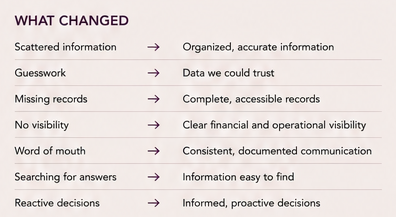
We went from information scattered across paperwork, people's memories and informal conversations to defined places and processes for capturing it.
We went from financial activity that was difficult to see as a whole to monthly and annual information that could support decisions and tax preparation.
We went from cash discrepancies that were difficult to explain to records that allowed us to trace what had happened.
We went from decades of accumulated paperwork to organized operational and permanent records.
We went from organizational information being heavily dependent on individual people to records that leadership could access directly.
We went from member communication depending heavily on whoever happened to be working to multiple communication channels inside and outside the building.
And as the organization became more complex, we moved from informal employee communication to regular two-way meetings without abandoning the communication methods that were still working.
WHAT I WOULD DO DIFFERENTLY
I don't think I would have tried to create a comprehensive information system from the beginning because we didn't yet know what information would actually matter.
Some of the most useful systems developed as we learned what information the organization actually needed. The Daily Shift Report grew out of the need to understand shift-level money. The financial workbook grew from the need to see the operation as a whole. The filing system grew from sorting through years of accumulated records. Employee meetings became necessary only after the organization had grown beyond what informal communication could support.
I would probably establish clearer ownership and access rules for digital assets earlier. We learned the hard way what can happen when one individual has sole control of an organizational communication channel.
But the larger approach would remain the same. I would build the information system around the information people actually need to use.
THE INFORMATION FLOW TAKEAWAY
Information Flow is about making sure useful information gets captured, organized, shared and placed where the people who need it can actually find it. The biggest change was that we could now do something with the information we had.
Information helped us find mistakes, understand money, manage inventory, communicate with employees, keep members informed, work with professional advisors and eventually make major organizational decisions.
Information became something we could use.

Financial Flow
Creating Financial Visibility, Accountability and Better Decisions
WHERE IT STARTED
The financial issues were some of the most urgent I inherited when I became manager.
Several years of tax filings were overdue. The organization had already lost one of its revenue-generating licenses because of unresolved tax issues and another important operating license was at risk. Employees were being paid outside a formal payroll system and there wasn't a reliable internal system for tracking the organization's financial activity.
The accounting firm hired before I arrived was already working on the most recent tax filing, so I immediately began communicating with them to keep that work moving.
At the same time, the daily operation wasn't producing enough reliable financial information. Sales, cash, credit cards, tips, payouts and expenses weren't being brought together in a way that showed us how the business was actually performing.
We had several financial problems to address, but they weren't all the same problem.
Some required immediate compliance work. Some required better operational controls. Others required a financial system that didn't exist yet.
ADDRESSING THE IMMEDIATE FINANCIAL PRIORITIES
I focused first on the issues that could affect our ability to continue operating. I worked closely with the accounting firm to complete the outstanding tax filing and address the past-due amounts needed to restore the gaming license.
I contacted the appropriate state agency once the license was back in good standing to make sure the updated tax information had been received and that our other operating license was no longer in danger because of the previous tax issues. We also moved employees onto formal payroll through the accounting firm.
Those steps addressed some of the immediate risks. We still needed an internal financial system to understand what was happening with the money every day.
CREATING FINANCIAL ACCOUNTABILITY AT THE SHIFT LEVEL
Operational Flow had to support Financial Flow before I could build anything meaningful around the numbers.
The new POS gave us reliable transaction information. The Daily Shift Report created accountability around the money connected to each shift.
Employees documented their sales and gaming payouts. They counted their assigned cash funds at the beginning and end of their shifts and signed off on the amounts. The incoming employee verified the outgoing employee's balances. Any discrepancy had to be documented along with what the employee had done to try to resolve it.
That process gave us something we hadn't had before: a way to follow the money.
We could compare the POS, cash records and shift documentation to figure out what had happened if something didn’t balance. In many cases, money that initially appeared to be missing had simply been placed somewhere else for another legitimate purpose. The controls gave us enough information to distinguish a process problem from an actual financial problem.

WHERE OTHER FLOWS ENTERED
Operational Flow: created the transaction, shift and inventory controls that made reliable financial tracking possible.
Information Flow: gave the financial activity a structure. Sales, expenses, payouts, inventory and gaming records became information we could compare and use.
Customer Flow: influenced what people purchased, which products we continued carrying and how pricing decisions affected their experience.
Fulfillment Flow: created fundraising activities and events that generated financial activity while requiring their own purchasing and cost decisions.
Strategic Flow: used financial information to support decisions about pricing, suppliers, professional services, compliance and eventually the organizational structure itself.

BUILDING THE FINANCIAL TRACKING SYSTEM
I needed a way to see the organization as a whole once the daily financial information became more reliable. I built an Excel workbook because I knew the software, could customize it around our operation and could create something the board could understand without needing accounting software experience.
I started with income. Sales were separated into cash and credit-card activity and then combined into total sales. I created additional categories for income from gaming activities, memberships and other revenue sources.
I separated tips, gaming payouts and miscellaneous payouts as well. Then I organized expenses using basic accounting categories, including cost of goods sold, professional services, payroll, operating expenses, supplies and other expenses. Additional categories included community donations, year-end bonuses, banking fees, licenses and insurance.
Each month showed the final profit or loss.
I also created an annual summary showing the monthly breakdown of each category. At tax time, the accountants received the annual summary along with the supporting Excel workbook. For the first time, we had one place where we could see how money was coming in, where it was going and what was left.
RECONSTRUCTING WHAT WE COULD
Building the workbook was easy. Populating it wasn't.
The new POS hadn't been installed at the beginning of the year, so the earliest months didn't have the same level of transaction documentation we had going forward.
I went back to the beginning of the current year and reconstructed the financial activity using the information we could support.
I made a deliberate decision not to go back and recreate the previous year's internal financial records because the accountants had already filed that year's taxes using the information available to them before I arrived. Trying to rebuild a year of financial history without reliable supporting records would have created numbers that looked complete without necessarily being accurate.
I wanted the system we built going forward to contain information we could actually support.
USING THE NUMBERS TO RUN THE BUSINESS
We started using the organized financial information to make better purchasing and pricing decisions. We compared supplier costs and discovered that some products cost less through other sources. We also changed where we purchased certain items and developed new supplier relationships when the pricing and overall value made more sense.
The financial information also helped with pricing. We could look at product costs, sales and overall financial performance before deciding whether prices needed to change and which products actually needed an increase.
Inventory added another layer. Combining sales information with POS inventory helped us identify products that weren't selling. That helped us make better purchasing decisions and reduce the amount of money tied up in slow-moving products.
The numbers were becoming part of how we ran the business.
CREATING BETTER CONTROLS AROUND GAMING ACTIVITY
Restoring the gaming license gave us another financial system to rebuild. I created a reporting structure that tracked how much money each game took in, how much was paid to winners and how much remained as proceeds. That gave us a way to compare actual results with what we expected a game to produce.
We could go back through the records to understand the results and investigate anything that didn't make sense.
We also began formally tracking community donations connected to gaming proceeds and maintaining the documentation required for gaming activity and reportable winnings. That gave us a much clearer financial picture of an important revenue source and created the records we needed to support ongoing compliance.
BRINGING FUNDRAISING INTO THE FINANCIAL STRUCTURE
A new volunteer group began fundraising near the end of my first year as manager. We intentionally didn't create a separate bank account or parallel financial structure for the group. Fundraising money moved through an existing organizational account used for community giving. That allowed the volunteers to concentrate on fundraising and community support without creating another financial system that someone would eventually have to administer and reconcile.
The first efforts included a donation drive benefiting a local community organization and small food sales. Then they grew.
Other affiliated groups contributed to the initial community initiative. Food sales became consistently successful and eventually expanded to include preorders and seasonal fundraising activities.
The volunteer group raised more than $7,000 during its first year and continued growing its fundraising after that. The money had a clear path from fundraising activity into the organization's existing financial structure and back out into community support.
FINANCIAL FLOW BECAME PART OF DECISION-MAKING
The biggest change was that we started using financial information to make decisions.
Purchasing decisions included actual costs. Pricing decisions included what products cost us and how they were selling. Inventory decisions included whether products were moving. We could evaluate gaming activities based on what they were actually producing.
Fundraising had a financial structure. Payroll had documentation. Professional services became something we evaluated based on whether we were getting the information and support the organization needed.
That financial clarity became even more important later when we began a major organizational restructuring. The restructuring created a separate operating entity responsible for the revenue-generating operation, licenses, operating revenue and expenses while the parent organization retained its own distinct responsibilities.
The legal structure was changing, but we already understood how the money moved through the operation.
WHERE OTHER FLOWS ENTERED
Operational Flow created the transaction, shift and inventory controls that made reliable financial tracking possible.
Information Flow gave the financial activity a structure. Sales, expenses, payouts, inventory and gaming records became information we could compare and use.
Customer Flow influenced what people purchased, which products we continued carrying and how pricing decisions affected their experience.
Fulfillment Flow created fundraising activities and events that generated financial activity while requiring their own purchasing and cost decisions.
Strategic Flow used financial information to support decisions about pricing, suppliers, professional services, compliance and eventually the organizational structure itself.
WHAT CHANGED
We went from financial activity spread across disconnected records and individual transactions to a system that showed revenue, expenses and monthly results together.
We went from limited shift-level financial accountability to documented reconciliation and verification.
We went from limited payroll documentation to a formal documented payroll system.
We went from purchasing based largely on existing supplier relationships to comparing costs and changing suppliers when the numbers supported it.
We went from inventory sitting on the shelf without a clear picture of demand to using sales and inventory together to make purchasing decisions.
We went from limited visibility into individual gaming activities to tracking receipts, payouts and proceeds.
We went from financial information primarily serving tax and compliance needs to using it throughout the year to run the business.
WHAT I WOULD DO DIFFERENTLY
I wouldn't start with more sophisticated accounting software.
Excel worked because it matched what we needed at the time. I knew it, the board could understand it and I could change the structure as I learned more about the operation. A more complicated system wouldn't have fixed unreliable source information.
I would establish the financial documentation standards earlier if I were walking into the same situation today. The hardest part was reconstructing activity that hadn't originally been documented with the expectation that someone would need to follow it later.
I would still start with the same basic question: Can I trust the information behind these numbers?
Once the answer is yes, the financial system can become as sophisticated as the organization actually needs.
THE FINANCIAL FLOW TAKEAWAY
Financial Flow gives a business the ability to understand what’s happening with its money and use that understanding to make better decisions.
Our financial system helped us understand costs, question supplier relationships, adjust purchasing, evaluate pricing, manage inventory, track gaming activity, support community giving and make larger organizational decisions.
We could see where the money was going, understand what the numbers were telling us and use that information to decide what needed our attention next.

Customer Flow
Creating a Place People
Wanted To Be
WHERE IT STARTED
The customer experience wasn't something I could separate from everything else happening in the organization.
Members and guests were walking into the same inconsistent operation the employees were trying to manage. The physical environment needed attention, daily routines varied depending on who was working and communication about events and activities often depended on asking the person behind the bar.
The organization also needed to rebuild its relationship with the community. Over time, it had developed a reputation that no longer reflected the organization we wanted it to be.
We all wanted people to enjoy being there, but I also wanted the organization to feel like what it actually was: a place built around veterans, members, their families and the community.
We needed to create an environment people wanted to be part of.
CREATING CONSISTENCY IN THE EVERYDAY EXPERIENCE
Some of the first improvements to Customer Flow came directly from Operational Flow.
The daily routines we established meant people walked into a cleaner, stocked and better-prepared space. Reliable staffing reduced the constant uncertainty around coverage. The new POS made transactions easier and the inventory systems helped us keep products available while identifying things people weren't actually buying.
None of those changes were particularly exciting from a customer perspective. But people experience operational problems whether they know what caused them or not. They notice when something isn't clean. They notice when the product they want isn't available. They notice when an employee is overwhelmed or doesn't know what's happening.
Creating a more reliable daily operation gave us the foundation for a better experience.

WHERE OTHER FLOWS ENTERED
Operational Flow: created the consistency underneath the experience. Reliable staffing, cleaner facilities, stocked inventory and repeatable daily routines made the organization easier to enjoy.
Information Flow: helped members and guests know what was happening through internal communication, displays, employees and online channels.
Financial Flow: helped us make better purchasing and pricing decisions while supporting the events, fundraising and community activity people valued.
Marketing Flow: extended the experience beyond the building by sharing events, community involvement and organizational activity with people who weren't already there.
Fulfillment Flow: made the events, food sales, fundraising activities and community efforts possible.
Strategic Flow: helped the organization make larger decisions about what it wanted to become and created the structure needed to support its continued growth.
CREATING THE RIGHT ENVIRONMENT
Consistency alone wasn't enough. The organization needed a personality.
We wanted it to be fun and welcoming. Members could relax, socialize and enjoy themselves. Guests and people attending public activities needed to feel comfortable walking through the door even if they hadn't been there before.
We were tolerant to a point. People didn't need to behave exactly the same way or fit into a particular social group to belong there. But behavior that disrupted everyone else's experience wasn't something we were willing to ignore.
We also began reinforcing the traditions and expectations that came with being a veterans' organization. The bar was part of the organization. It wasn't the organization's entire identity.
That balance mattered. We could create a place where people had fun without losing sight of why the organization existed in the first place.

MAKING PEOPLE FEEL WELCOME
The organization served several different groups of people.
There were longtime members, newer members, families, guests and people connected to affiliated groups. There were also members transferring from other veterans' organizations and people from the community attending public activities.
They didn't all walk through the door with the same relationship to the organization. We didn't need them to. The expectation was that people who came in would be treated like they belonged there as long as they respected the organization and the people around them.
Our employees played an enormous role in that experience.
We eventually had a group of experienced bartenders with strong personalities and their own relationships with members. People had favorite bartenders and certain shifts developed their own following.
That wasn't something I tried to standardize out of the experience. Reliability mattered. Expectations mattered. How employees treated people mattered. Their personalities could still be their own.
GIVING PEOPLE REASONS TO COME BACK
The experience eventually expanded beyond simply coming in for a drink. We actively asked for ideas for activities and events and began testing things people might enjoy.
Live music became part of our summer activities and eventually expanded into other celebrations and larger events. Sporting events created another reason for people to gather. Affiliated groups hosted increasingly popular seasonal activities and food events. Some were open to the broader community.
Food sales and fundraising created another kind of experience. What began with relatively small fundraising efforts grew into popular food sales, preorders and seasonal activities that people began expecting and supporting.
The organization became more active because people participated. Their participation gave us the confidence to try more.
PAYING ATTENTION TO WHAT PEOPLE RESPONDED TO
We didn't have a formal customer research program. We could see what people responded to.
We knew which events filled the room, which food sold out and which products weren't moving. We also knew which employees developed loyal followings and which nights consistently became busier.
People also told us what they wanted. Members suggested activities. Employees brought ideas from conversations they were having during their shifts. Affiliated groups developed their own events and brought people from other organizations into ours.
We paid attention.
Not every suggestion became something we pursued, but the organization became more responsive because we had more ways to understand what people enjoyed and what gave them a reason to participate.
RECONNECTING WITH THE COMMUNITY
Customer Flow eventually extended well beyond the people sitting inside the building. The organization became more involved in the community again.
Fundraising supported local causes. We participated in food drives and other efforts supporting veterans. Volunteers developed community fundraising activities and affiliated groups expanded their own outreach.
We also found small ways to stay connected with members who couldn't participate the way they once had, including outreach to members living in local care facilities.
Those activities were part of being a community organization. They also changed the relationship between the organization and the community. People could see what we were doing, participate in it and understand that the organization existed for something beyond the activity happening inside the building.
GROWTH FOLLOWED THE EXPERIENCE
Membership began growing. Some people joined for the first time. Others transferred from nearby veterans' organizations. Affiliated groups developed stronger relationships with their counterparts in the region and those connections brought more people into our activities.
Friday nights became busier. Regular events developed their own crowds. Public activities introduced people to the organization who might not otherwise have walked through the door.
We weren't running a formal membership-growth campaign. People were coming because they enjoyed being there. They were welcomed. There were things happening. The organization was active in the community and the environment had become one people wanted to return to.
Growth became an outcome of the experience we were creating.
SETTING BOUNDARIES WAS PART OF THE EXPERIENCE TOO
Creating a welcoming environment didn't mean saying yes to everything or allowing every behavior. We also protected the customer experience by being firm when we needed to be.
Employees needed clear expectations. Members were responsible for their behavior and for the guests they brought with them. Organizational traditions needed to be respected and behavior that interfered with other people's ability to enjoy the space had to be addressed.
We formalized more of those expectations over time through operating rules and employee requirements. The boundaries helped us protect what people enjoyed about being there.
A good experience depended just as much on what we were willing to address as what we were willing to offer.
WHERE OTHER FLOWS ENTERED
Operational Flow created the consistency underneath the experience. Reliable staffing, cleaner facilities, stocked inventory and repeatable daily routines made the organization easier to enjoy.
Information Flow helped members and guests know what was happening through internal communication, displays, employees and online channels.
Financial Flow helped us make better purchasing and pricing decisions while supporting the events, fundraising and community activity people valued.
Marketing Flow extended the experience beyond the building by sharing events, community involvement and organizational activity with people who weren't already there.
Fulfillment Flow made the events, food sales, fundraising activities and community efforts possible.
Strategic Flow helped the organization make larger decisions about its future while protecting the experience members and guests already valued.
WHAT CHANGED
We went from an inconsistent daily customer experience to a more reliable environment regardless of who was working.
We went from people depending heavily on employees to know what was happening to multiple ways of communicating events and activities.
We went from an experience centered heavily around the bar to one that more clearly reflected veterans, members, families and community.
We went from fewer reasons to participate beyond the everyday bar experience to regular events, food activities, fundraising and community involvement.
We went from people primarily coming to use the bar to people coming for events, relationships, activities and opportunities to participate.
We went from a weakened community reputation to stronger community involvement and renewed participation.
And membership grew along with it.
WHAT I WOULD DO DIFFERENTLY
I don't think I would have started with a formal customer experience plan.
I would still start by understanding the people who were already there and creating an operation capable of serving them consistently.
I would probably have created more intentional ways to capture feedback as the organization grew. We learned a tremendous amount through conversations, employee observations, participation and simply paying attention to what people responded to, but more structured feedback could have helped us identify patterns sooner.
I would still protect the informal relationships that made the organization feel like a community. People weren't data points. Knowing them was part of understanding the experience we were creating.
THE CUSTOMER FLOW TAKEAWAY
Customer Flow is the experience people have with a business or organization across every interaction, not just the service they receive during a transaction.
Our Customer Flow improved because the operation became more reliable, communication became clearer, people had more reasons to participate and the organization became more connected to the community it served.
People felt welcome. They knew what was happening. They brought other people with them. They participated, volunteered, attended events and came back.
We created a place people wanted to be part of.

WHERE IT STARTED
The organization wasn't invisible when I became manager. People already knew it existed and members had their own established ways of finding out what was happening.
Most communication happened inside the building. Printed signs advertised upcoming activities and three dedicated bulletin boards shared information from affiliated groups, other veterans' organizations and the community.
Members also asked employees what was happening and relied on word of mouth. A social media page already existed, but it wasn't particularly active.
The larger problem was that none of those channels consistently showed everything the organization was doing or gave people outside the building much reason to pay attention.
That became more important as the organization itself began changing. We were becoming more active. We were reconnecting with the community, creating events, supporting veterans and local causes and giving members more ways to participate.
We had more to communicate.
GIVING PEOPLE SOMETHING WORTH TALKING ABOUT
Marketing wasn't one of the first things I tried to fix. The daily operation needed attention. Financial and licensing issues were more urgent. We needed reliable employees and better systems to support the business.
The organization also needed to become something we actually wanted to make more visible.
The story changed as those pieces began coming together.
Events gave people reasons to gather. Volunteers created fundraising activities. Affiliated groups expanded their events and outreach. We supported local causes and veterans' initiatives. The organization became more active and welcoming.
That gave Marketing Flow something real to work with. We were becoming an active organization.
CREATING CONSISTENT VISIBILITY
I began using the existing social media page to regularly share what was happening.
I posted upcoming events, fundraising activities, community initiatives, veterans' information and resources and other things members and the broader community had a reason to know. I introduced new employees and shared some of the smaller things happening inside the organization alongside the larger events.
We began consistently showing people what was happening instead of relying on occasional announcements.
We also needed better communication with the people already walking through the doors. We installed a CCTV information display inside the bar and used it to share upcoming events, activities, organizational information and community initiatives. I updated it at least weekly and more often when something changed.
That gave us two very different but complementary marketing channels. The social media page helped us reach people outside the building. The CCTV helped us reach people who were already there.
Marketing Flow
Making The Organization Visible Again

WHERE OTHER FLOWS ENTERED
Organizational Flow: created the stability underneath what we were communicating. Marketing could bring people through the door, but the daily operation still had to deliver the experience they expected.
Information Flow: gave us something accurate and useful to communicate. The CCTV, social media, printed materials and employees became different ways of moving information to different audiences.
Financial Flow: helped support the events, activities and community initiatives we communicated while giving us better information for decisions about what we could reasonably do.
Customer Flow: gave the marketing credibility. People enjoying the organization, returning, participating and bringing others reinforced the story we were sharing publicly.
Fulfillment Flow: created many of the events, fundraising activities and community efforts that gave people reasons to engage with the organization.
Strategic Flow: helped the organization become clearer about what it wanted to represent and where its priorities belonged.

USING THE SAME INFORMATION MORE THAN ONCE
We didn’t need different marketing content for every channel. I frequently created information for the CCTV and then adapted it for social media with additional text that gave people more context or a reason to pay attention.
An upcoming event could appear on the screen inside the building and then become a social post. A fundraising activity could be communicated to members while also being shared with the broader community. Veterans' information could reach the people sitting at the bar and people following us online.
That made the marketing manageable. We were taking information that already mattered and putting it where different people could see it.
MARKETING MORE THAN EVENTS
Events gave us plenty to promote, but I didn't want the social media page to become an endless collection of event announcements. The organization existed for more than that.
We shared veterans' resources and information. We talked about food drives and community giving. We shared outreach activities and supported initiatives happening elsewhere in the veterans' community.
We also showed some of the people behind the organization. New employees were introduced. Volunteer efforts became visible. Community activities gave people a better sense of what the organization was doing beyond its own walls.
That helped our marketing reflect more of the organization's identity. People could see the events they could attend, the community work they could support and the resources available to them. They could also see why the organization existed.
REBUILDING A MARKETING ASSET WE DIDN'T CONTROL
One of the more frustrating lessons came from the social media page itself.
The original page had been created before I became manager and control of it remained with an individual rather than the organization. By then, the page had grown organically to more than 800 followers. We eventually lost the page and everything we had built around it.
I had to start over. I created a new organizational page and began rebuilding the audience and communication history from the beginning.
The experience exposed a weakness that had very little to do with marketing content and everything to do with the system behind it. An organizational marketing asset shouldn't depend entirely on one person's account, access or willingness to cooperate.
The new page began building an organic following again, but having to rebuild something we had already created reinforced the importance of treating digital channels as organizational assets rather than simply places to post.
LETTING RELATIONSHIPS EXTEND OUR REACH
Our own channels weren't the only way people heard about us. Members talked to other people. Employees had their own relationships in the community. Affiliated groups connected with similar groups throughout the region and supported one another's activities.
Public events expanded that reach further. People came into the organization for food activities, fundraising events, live entertainment, community initiatives and larger gatherings. Some already knew members. Others had connections through affiliated organizations or simply heard that something was happening.
That meant Marketing Flow wasn't limited to what we published ourselves. Relationships carried information too. The more connected the organization became, the farther that information traveled.
MAKING THE CHANGE VISIBLE
The organization had been working to rebuild its reputation in the community. Marketing alone couldn't do that.
Better social posts couldn't fix an inconsistent customer experience. Event announcements couldn't create community involvement that wasn't happening. Marketing couldn't make the organization more welcoming or create meaningful outreach by saying those things were true.
The organization had to do the work first and marketing made that work visible.
People could see the events. They could see the fundraising. They could see the community support, veterans' initiatives and increasing activity. Over time, the story people could see from the outside became much closer to the experience people were having inside.
GROWTH WITHOUT A FORMAL MARKETING CAMPAIGN
We didn't need an elaborate marketing campaign for what we were trying to accomplish.
We communicated consistently. We gave people useful information. We promoted activities worth attending and showed what the organization was contributing to its members and community.
The social media audience grew organically. Events became better attended. Public activities brought new people through the doors. Membership grew and people transferred from other veterans' organizations.
Marketing wasn't solely responsible for that growth. It helped people see what was already changing. Customer experience, events, community involvement, relationships and word of mouth all contributed. Marketing connected those things and gave them greater visibility.
WHERE OTHER FLOWS ENTERED
Marketing Flow depended on almost every other Flow.
Operational Flow created the stability underneath what we were communicating. Marketing could bring people through the door, but the daily operation still had to deliver the experience they expected.
Information Flow gave us something accurate and useful to communicate. The CCTV, social media, printed materials and employees became different ways of moving information to different audiences.
Financial Flow helped support the events, activities and community initiatives we communicated while giving us better information for decisions about what we could reasonably do.
Customer Flow gave the marketing credibility. People enjoying the organization, returning, participating and bringing others reinforced the story we were sharing publicly.
Fulfillment Flow created many of the events, fundraising activities and community efforts that gave people reasons to engage with the organization.
Strategic Flow created a stronger organizational structure underneath the growth and activity we were making visible.
WHAT CHANGED
We went from communication depending heavily on signs, word of mouth and whoever happened to be working to multiple consistent channels inside and outside the building.
We went from an underused social media presence to an active page that grew to more than 800 organic followers, then rebuilt the audience after losing access to the original page.
We went from primarily announcing activities to sharing events, community involvement, veterans' information, fundraising, people and organizational activity.
We went from creating information for one place at a time to adapting useful information across multiple channels.
We went from a digital marketing asset controlled by an individual to rebuilding with a clearer understanding of organizational ownership and access.
We went from limited visibility into what the organization was becoming to consistently showing people the activity, community involvement and experience behind it.
And we did it without trying to make the marketing look bigger than the organization itself.
WHAT I WOULD DO DIFFERENTLY
I would establish ownership and access rules for every digital marketing asset from the beginning.
Losing the original social media page made that lesson very clear. An organization needs to know who owns its accounts, who has administrative access and what happens to that access when someone leaves or their role changes.
I would also create a slightly more intentional system for documenting what we were doing.
We had years of events, fundraising, community involvement and growth, but our focus was usually on doing the work and communicating what was happening next. A stronger archive of photos, results, participation and milestones would have made it easier to look back and understand how much had changed.
I still wouldn't start with a complicated marketing strategy. I would start by understanding what the organization was doing, who needed to know about it and the simplest ways to consistently connect the two.
THE MARKETING FLOW TAKEAWAY
Marketing Flow gives people a way to see, understand and connect with what a business or organization is doing.
Our marketing became stronger because there was increasingly more substance behind it. We had events to share, community involvement to talk about, useful information to distribute and an experience people wanted to return to.
Marketing made the transformation visible.

Fulfillment Flow
Building the Capacity to Reliably Deliver More
WHERE IT STARTED
Fulfillment Flow looked different in this organization because we weren't delivering one primary product or service.
We were running the daily bar operation while also supporting events, food sales, fundraising, community initiatives and activities hosted by affiliated groups. Each one required people, supplies, communication, preparation and follow-through. Some of those activities already existed in different forms. Others developed as the organization became more active.
We needed enough operational capacity and volunteer support to actually deliver what we committed to doing without creating unnecessary chaos around it.
That became increasingly important as participation grew.
BUILDING THE CAPACITY TO DO MORE
The early Operational Flow work created much of the foundation for Fulfillment Flow.
Reliable staffing meant we could plan around who would actually be working. Opening and closing routines kept the daily operation from falling apart every time something extra was happening. Better inventory and purchasing processes helped us understand what we had and what we needed.
Communication systems gave employees, volunteers and leadership better ways to coordinate.
Those systems weren't built specifically for events or fundraising. They gave us the capacity to add those things without rebuilding the operation every time we tried something new.
STARTING WITH WHAT WE COULD MANAGE
Some of our earliest organized fundraising activities were intentionally straightforward.
A volunteer group formed near the end of my first year as manager and began looking for ways to support the community. One of the first efforts was a donation drive benefiting a local community organization.
Food sales followed. We started with one primary food item that was inexpensive to prepare and affordable for members. We approached a local grocery business about consistently honoring its sale price for one of our main ingredients and they agreed. That gave us a more predictable cost every time we held the sale. A volunteer handled part of the preparation at home and we completed the remaining preparation onsite. We sold out regularly.
Demand eventually led us to begin accepting preorders from members. We later opened preorders to the broader community as long as orders were paid in advance. We experimented with other food options and seasonal activities as well. Some worked better than others.
We paid attention and continued the things people consistently supported.
CREATING A REPEATABLE PROCESS AROUND FOOD SALES
The food itself was only one part of fulfillment.
Someone had to decide what we were offering, determine quantities, purchase ingredients, prepare the food, communicate the sale, collect preorders, track payments, complete the final preparation and get the orders to the people who had purchased them.
The volunteer group became an important part of that process. Different people contributed where they could. Some prepared food. Some helped with ordering or setup. Others helped during the sale or with cleanup.
Preorders also made fulfillment easier to manage. They gave us a better idea of demand before we purchased and prepared everything and reduced some of the financial uncertainty around opening sales to the public.
The process became familiar. We didn't have to reinvent the entire activity every time we held another sale.

WHERE OTHER FLOWS ENTERED
Operational Flow: created the staffing, inventory, routines and daily stability that allowed us to add events and activities without constantly disrupting the business.
Information Flow: helped employees, volunteers, members and leadership understand what was happening, what needed to be prepared and where responsibilities belonged.
Financial Flow: helped us understand costs, manage purchasing, track fundraising activity and give the money we raised a clear path through the organization's financial structure.
Customer Flow: showed us what people valued through participation, repeat attendance, preorders and their response to different activities.
Marketing Flow: helped people know what we were offering, when it was happening and how they could participate.
Strategic Flow: helped the organization make larger decisions about its priorities while the fulfillment systems continued supporting the activity happening every day.

EXPANDING INTO LARGER EVENTS
Live events added another level of complexity.
We started with a summer series that brought in one live music event per month. As those events became popular, live entertainment expanded into other celebrations and larger organizational activities.
Affiliated groups were growing their own events at the same time. Seasonal food activities became larger. Sporting events brought crowds into the building. Fundraising and community activities continued alongside everything else. Each activity had its own needs, but all of them depended on the same underlying operation.
I had a large role in organizing many of the events, while volunteers frequently handled food preparation and ordering. Leadership, affiliated groups, members and other volunteers contributed to setup, service and cleanup depending on the activity.
Fulfillment became shared work.
DESIGNING AROUND THE PEOPLE AND SPACE WE ACTUALLY HAD
More people didn't automatically mean we added more employees to every event. The physical workspace behind the bar was small. Adding another bartender could sometimes make service harder.
Our experienced bartenders were comfortable managing crowds and our regular customers understood that a busy event could mean waiting a little longer. So most events continued with one bartender.
That decision worked because we understood the space, the employees and the people we were serving. We weren't trying to create an ideal staffing model on paper and force it onto an environment where it didn't make sense. We built fulfillment around the operation we actually had.
Volunteers helped absorb some of the work outside the bar. They assisted with food, setup and cleanup, which allowed the bartender to stay focused on customers.
LETTING DEMAND SHAPE WHAT WE CONTINUED
Not everything we tried needed to become permanent. Food sales gave us a clear example.
Some items consistently sold out. Others generated less interest. We paid attention to participation and adjusted instead of continuing an activity simply because we had already created it.
Events worked the same way. Participation told us which activities had enough interest to repeat or expand. Employees and members suggested ideas. Affiliated groups brought their own successful activities into the broader organizational calendar. We could do more because we weren't trying to keep doing everything.
Fulfillment improved when we concentrated our effort on the things people actually valued.
COORDINATING MORE AS THE ORGANIZATION GREW
Informal coordination worked surprisingly well for a long time.
Employees communicated through the dedicated group text. Volunteers knew one another and often coordinated naturally. Leadership and affiliated groups handled their own responsibilities while communicating with me about the parts that affected daily operations.
Growth eventually changed that. More events meant more schedules, purchasing, food preparation, staffing and communication happening at the same time. Activities could overlap and decisions made by one group could affect another.
The semi-monthly employee meetings helped us communicate upcoming activities and identify potential operational issues before they affected an event.
We didn't replace the informal communication that still worked. We added more structure when the amount of activity required it.
CONNECTING FULFILLMENT TO COMMUNITY IMPACT
Some of the most meaningful things we delivered weren't events at all. Fundraising created resources the organization could put back into the community. Volunteer activities supported local causes and veterans. Affiliated groups expanded their own fundraising and outreach.
What started with a small community donation effort grew as more people participated. The volunteer group raised more than $7,000 during its first year and continued growing its fundraising efforts after that. Other affiliated groups also contributed to community initiatives.
Delivering those results required the same Fulfillment Flow as any other commitment.
Someone still had to organize the activity, communicate it, collect the money or donations, complete the work and make sure what had been promised actually reached the people it was intended to support.
The outcome was different. The need for follow-through wasn't.
WHERE OTHER FLOWS ENTERED
Fulfillment Flow depended on every other Flow.
Operational Flow created the staffing, inventory, routines and daily stability that allowed us to add events and activities without constantly disrupting the business.
Information Flow helped employees, volunteers, members and leadership understand what was happening, what needed to be prepared and where responsibilities belonged.
Financial Flow helped us understand costs, manage purchasing, track fundraising activity and give the money we raised a clear path through the organization's financial structure.
Customer Flow showed us what people valued through participation, repeat attendance, preorders and their response to different activities.
Marketing Flow helped people know what we were offering, when it was happening and how they could participate.
Strategic Flow helped the organization make larger decisions about its priorities while the fulfillment systems continued supporting the activity happening every day.
WHAT CHANGED
We went from activities depending heavily on informal effort to repeatable ways of planning, preparing and delivering them.
We went from an initial fundraising effort to a volunteer group that raised more than $7,000 during its first year and continued growing its impact.
We went from individual food sales to repeatable purchasing, preparation, preorder and payment processes.
We expanded from individual activities to regular live entertainment, food sales, fundraising, community initiatives and larger gatherings.
We went from assuming more activity required more staffing to designing events around the physical space, employee capabilities and volunteer support we actually had.
We went from trying activities and simply continuing them to paying attention to participation and concentrating our effort on what people supported.
And we increased what the organization could deliver without rebuilding the daily operation every time we added something new.
WHAT I WOULD DO DIFFERENTLY
I would document event and food-sale processes earlier once they became repeatable.
A lot of the knowledge lived with the people who regularly did the work. That worked because we had an experienced group of employees and volunteers who knew one another and understood how things came together.
Better documentation would have made those activities easier for someone new to step into and would have reduced some of the dependence on individual knowledge.
I would also create a more consistent way to review activities after they happened. We knew what sold out, what drew a crowd and what people talked about, but a simple review of participation, costs, workload and lessons learned could have helped us improve the next event more intentionally.
I wouldn't add structure simply for the sake of making the process look more formal. I would still build the fulfillment process around the people doing the work, the resources available and what we had actually committed to deliver.
THE FULFILLMENT FLOW TAKEAWAY
Fulfillment Flow is what turns an idea, offer or commitment into something people can actually receive.
For us, that meant much more than serving customers during normal business hours. It meant delivering food sales, events, fundraising activities, community initiatives and other commitments while the everyday operation continued around them.
The systems gave us the capacity to keep our commitments and do more of what people valued.

Strategic Flow
Building a Structure the Organization Could Continue to Grow On
WHERE IT STARTED
The need for stronger Strategic Flow was clear from the beginning, even though the largest strategic work came much later.
I inherited several problems that required immediate attention. Years of overdue tax filings had already affected one revenue-generating license and put another operating license at risk. Payroll needed to be formalized. Financial records were incomplete and the daily operation needed basic systems and accountability.
Leadership also knew there was a much larger organizational issue waiting for us. The organization wasn't structured the way its governing body required. The revenue-generating operation needed to become legally separate from the parent organization and we were running out of time to address it.
We couldn't ignore that problem. We also couldn't make it the first problem we solved. The immediate work had to stabilize the organization enough for us to take on a complicated restructuring without losing control of everything else in the process.
PRIORITIZING WHAT HAD TO HAPPEN FIRST
Strategy during those early years meant deciding what needed our attention now, what could wait and what had to be built before something else became possible.
The tax and licensing issues could threaten our ability to operate, so they came first. Payroll needed to become compliant. We needed reliable transaction records and financial information. Daily operations needed enough structure that the business didn't require constant intervention.
Some work happened at the same time. Other work had to wait. The larger organizational restructuring remained on the horizon while we addressed the things that could prevent us from reaching it.
That sequencing mattered. We weren't postponing strategy.
Choosing the right order was a strategic decision.
BUILDING STABILITY BEFORE RESTRUCTURING
The organization became much more stable over the next several years.
Operational systems created repeatable daily routines and accountability. Information became easier to capture, find and share. Financial tracking gave us better visibility into revenue, expenses and decision-making. Customer experience improved. Events, fundraising and community involvement grew.
Membership grew too.
None of that eliminated the need for the organizational restructuring but it changed the environment in which we would eventually have to complete it. Instead of trying to restructure an organization while every part of the daily operation was still unstable, we had functioning systems underneath us.
The organization could continue operating while we worked on its future.

WHERE OTHER FLOWS ENTERED
Operational Flow: created enough daily stability for leadership to work on a major restructuring without constantly rebuilding the business underneath it.
Information Flow: became critical for documentation, professional communication, regulatory filings, membership information and formal decision-making.
Financial Flow: gave us a clearer understanding of how money moved through the operation and helped us establish appropriate financial responsibilities under the new structure.
Customer Flow: gave us something worth protecting. The restructuring needed to happen without disrupting the experience members and guests already valued.
Marketing Flow: helped us maintain communication and visibility while much of the strategic work happened behind the scenes.
Fulfillment Flow: allowed events, fundraising and community commitments to continue while leadership worked on the larger organizational changes.

RECOGNIZING WHEN PROFESSIONAL SUPPORT WASN'T WORKING
Leadership had already begun discussing the required restructuring with the accounting firm engaged before I became manager.
As the work became more complicated, we needed clear answers, documentation and follow-through. We weren't consistently getting them. Information we were told had been filed couldn't always be substantiated. Questions weren't being answered clearly and we couldn't afford to assume that important compliance work had been completed simply because someone said it had.
I had also begun working with an attorney who understood the restructuring and the regulatory issues connected to the operational side of the organization. She eventually recommended another accounting firm.
The new accounting firm reviewed the situation and redid required filings where we couldn't verify the previous work. They also recommended a payroll provider that could take over the organization's payroll processing.
Changing professional relationships wasn't a minor administrative decision. We needed advisors who could support where the organization was going, not simply maintain the relationship we already had.
CREATING THE RIGHT ORGANIZATIONAL STRUCTURE
The restructuring formally separated the revenue-generating operation from the parent organization. The operating entity became responsible for the day-to-day business, operating revenue and expenses, applicable licenses and the assets used to run that operation. The parent organization retained its own distinct organizational responsibilities and assets.
The purpose was to create the organizational structure required for the operation and reduce the risk created when the two functions existed together without enough legal separation. The work required state and federal filings, organizational documents, separate governing documents and appropriate insurance coverage for each entity.
We also needed to establish the correct tax identification structure and make sure existing registrations and licenses aligned with the new organization. This wasn't a matter of filling out one form and changing a name. Each decision affected something else.
CHANGING COURSE WHEN EXISTING SYSTEMS COULDN'T SUPPORT THE STRATEGY
Insurance became another example. Our existing insurance provider struggled to understand the coverage requirements created by the new structure. We needed different policies for the two entities and the operating side required broader coverage because of the activities and risks associated with the business.
We eventually moved to another local insurance professional who understood the structure and had experience with the organization and community.
That decision followed the same principle as changing accountants. Existing relationships weren't automatically the right relationships simply because they were familiar.
The organization needed professional support that matched what we were trying to build.
BRINGING THE MEMBERSHIP INTO THE DECISION
The restructuring couldn't happen only between leadership, attorneys and accountants. Voting members had formal decision-making rights.
We prepared information explaining the proposed structure and provided it in advance so members had time to review it. Meetings gave people the opportunity to ask questions and understand what the changes meant before formal votes were held.
A similar process supported the approval of operating rules and organizational documents.
All of that required patience. Major organizational decisions move differently when the people affected by them also have a formal voice in approving them.
Our job was to give people enough information to understand what they were being asked to decide.
PROTECTING WHAT ALREADY WORKED
One of the most important things about the restructuring was what didn't change. Members didn't experience a different organization when they walked through the door. Employees didn't suddenly need new daily systems.
The POS still worked. The shift reports still worked. The scheduling process still worked. Financial tracking continued. Inventory, communication and daily routines continued.
We had built the earlier systems around what the operation actually needed rather than around an organizational label. That meant we didn't have to dismantle years of work to accommodate the new legal structure.
The structure changed around an operation that already worked.
STRATEGY CONTINUED WHILE THE ORGANIZATION KEPT MOVING
The restructuring wasn't happening in isolation. Employees still needed schedules. Bills still had to be paid. Members still expected the doors to open. Events continued. Fundraising continued. Community activities continued.
The organization was also growing. That meant strategic work had to coexist with daily work for an extended period. Some parts of the restructuring moved quickly. Others depended on professional advisors, regulatory filings, notice periods, meetings or formal votes. Waiting for one piece didn't mean everything else stopped.
We continued working on what could move while keeping track of what depended on something we couldn't control yet.
That was how we had worked from the beginning: keep moving what we could while other pieces had to wait.
WHERE OTHER FLOWS ENTERED
Strategic Flow depended on the systems we had already built throughout the organization.
Operational Flow created enough daily stability for leadership to work on a major restructuring without constantly rebuilding the business underneath it.
Information Flow became critical for documentation, professional communication, regulatory filings, membership information and formal decision-making.
Financial Flow gave us a clearer understanding of how money moved through the operation and helped us establish appropriate financial responsibilities under the new structure.
Customer Flow gave us something worth protecting. The restructuring needed to happen without disrupting the experience members and guests already valued.
Fulfillment Flow allowed events, fundraising and community commitments to continue while leadership worked on the larger organizational changes.
The Flows made the strategic work possible.
WHAT CHANGED
We went from an organizational structure that didn't meet governing requirements to a formally separated operating and parent structure.
We went from relying on professional relationships that weren't providing the documentation and support we needed to advisors who could help us complete the work.
We went from uncertainty about whether important filings had actually been completed to verified filings and professional oversight.
Responsibilities that had previously existed under one organizational structure became clearly defined between the two entities.
We went from insurance that no longer matched what the organization needed to coverage structured around the responsibilities and risks of each entity.
We went from a major strategic requirement sitting in the background to completing it without dismantling the operational systems we had spent years building.
And we did it while the organization continued operating, growing and serving its members and community.
WHAT I WOULD DO DIFFERENTLY
I would have established clearer expectations for professional advisors much earlier. Responsiveness, documentation and the ability to explain what had been completed should have been explicit requirements rather than something we assumed would come with the relationship.
I would also create a more formal strategic roadmap once the immediate compliance problems were under control. We knew the restructuring had to happen and we understood many of the major pieces, but the process depended on enough outside parties that it could become difficult to see what was waiting, what was moving and what depended on something else.
A simple roadmap showing decisions, dependencies, professional responsibilities, regulatory steps and membership approvals would have made the larger process easier to see.
I wouldn't have moved the restructuring ahead of the earlier stabilization work. The organization needed functioning operations, reliable information and financial visibility underneath it.
The order mattered.
THE STRATEGIC FLOW TAKEAWAY
Strategic Flow gives a business or organization a way to decide where it's going, what needs to happen to get there and what has to come first.
For us, strategy wasn't a plan sitting separately from the daily operation. It meant deciding what required immediate attention, what needed to be built first and how to move a major structural change forward without disrupting everything that already worked.
We didn't stop running the organization so we could build its future. We built enough stability to do both.